Less is More in 2014 [ Five Resolutions for Your Emotional Health ]

The New Year can be a time of feeling refreshed – of experiencing excitement and purpose in leaving old habits in the dust, creating new goals, and perhaps even pursuing challenging adventures! Maybe 2013 was full of disappointment and heartache. As a result, you are nothing but utterly ready to shed those bad experiences and discover new beginnings. Oppositely, perhaps your 2013 was a year of great joy, love, and achievement. Possibly, you are eager for what awaits in 2014, hopeful that good things continue in the positive direction they have been headed.

Either way 2014 is upon us. What will it mean for you?

“Our lives are not determined by what happens to us but how we react to what happens, not by what life brings us but the attitude we bring to life.”  ~ Wade Boggs

Many resolutions focus on the external actions and decisions we make, and this is great! However, it is important to recognize that our behaviors spring forth from the beliefs, thoughts, and attitudes we hold. I have created a list of moment-by-moment internal resolutions, which can greatly impact the way you react to the events & people awaiting you in 2014.

1. Less Ruminating : As a therapist, I am a big fan of introspection (thinking carefully and processing thoughts and feelings deeply). Introspection is important and can provide clarity, self-awareness, & direction. Yet, ruminating carries us into a darker realm where obsessive thought &  worry reside.  We may think of it as getting “stuck in our own heads.” It can occur when we are so focused on one idea, event, or worry that we are distracted from the here-and-now. Unfortunately, feelings of anxiety and depression often coincide with ruminating. Instead of ruminating, perhaps there is room for More Writing.  I often encourage my clients to journal. When our minds are overwhelmed, writing can be a great way of getting jumbled thoughts out of the darkness of our heavy minds and into the light in a very tangible manner. By carving out time in your day or week to journal, you are providing yourself with practical boundaries in the expression of certain thoughts & feelings. Writing can be empowering in that it gives voice to the activity of your mind & can provide peace and at times even closure when challenged with difficult thoughts and situations.

2. Less Negative Self-Talk : I have discussed self-talk on the Blog several times before because I believe it to be critical to individuals’ overall emotional health. Self-talk quite simply includes the words we tell ourselves.  Negative self-talk can appear as, “I’m a failure.” or “I look hideous today.” or “I will likely embarass myself in this job interview.” Negative self-talk is nasty and by participating in it, we are often setting ourselves up for failure. Negative self-talk is not only degrading, it is simply untrue. By viewing ourselves with only our imperfections or mistakes in mind, we are wrongly filtering-out the beauty and capability alive within us.  Instead of negative self-talk, consider offering yourself More Kindness. In contrast to negative self-talk, positive self-talk implies taking a position of kindness towards oneself. Many people so easily give kindness to family, friends, & even strangers yet struggle to see themselves through the lens of understanding and grace. In my Blog post, “The Good News of Being ‘Messy”“, I discuss this idea of valuing how you are created uniquely and dare I say beautifully.

3. Less Comparison : This is an important one, and it is closely tied with #2 above. In my Blog post, “Shaking off Comparison,” I discuss the very common hole many of us find ourselves in when we constantly measure our own worth by comparing ‘me to you.’  For so many reasons this is unhealthy and can lead to negative self-talk (mentioned above). And while self-degradation is reason enough to work on issues of comparison, there is another nasty side effect of comparison we often forget: damage to our relationships with others.  When we compare, we are- perhaps subconsciously- viewing the other person as an enemy. How often does this damage our ability to genuinely connect with those around you? Instead of comparison, how about this one: More Encouraging OthersTaking note of others’ accomplishments does not have to equate de-valuing your own abilities and personality.  In fact, praising the success and the positive qualities of family members, friends,  colleagues, and classmates displays a level of humility, which can be a reflection of genuine confidence in oneself.  Appreciating and vocalizing encouragement to others can also offer relief from the often draining cycle of continual self-appraisal. Looking outside of oneself and authentically supporting another individual can deepen healthy relationships, build the other person up, and simply stated- feels good.

4. Less Assuming : Working with couples and experiencing marriage myself has served to highlight the importance of this one. Jumping to assumptions and often the ‘worst-case’ conclusions in both romantic relationships and friendships hurts you, the other person, and your relationship together. In relationships, we may notice we tend do this as a form of self-defense. Fearful of being hurt or having past mistakes repeated, we may defiantly assume that we know the thoughts and intentions of the other person. Doing so can create unnecessary stress for us and anger on the part of your partner. I talk more in-detail about hostile communication, including the tendency to assume wrongly in my Blog post, “Throwing Paperclips: Relationship Conflict & Communication”.  In 2014, how about More Listening. What do happy and successful couples do? They listen. And it is the same with close friendships. It is simple but often overlooked that in relationship we cannot 100% know the thoughts, feelings, and intentions of the other person. We so desperately need to be intentional in asking questions and listening to the answers. Anger may block us from this – feeling frustrated may propel us in the direction of blame and shaming; yet, this only leaves us and them with relational scars. Listening – rather than attacking – can save not only your relationship but rescue your emotional health.

5. Less Fear : Each of us experience fear – it is a natural response to an unpredictable world. Some of you have experienced very real, deep pain in your lives. Perhaps 2013 presented you with more than you thought you could bear at once. For you, perhaps fear is very much alive.  For others of you, possibly you have been living in fear for a long time. Either you experienced hurt many years ago or you witnessed damage inflicted on loved ones, and this has left you feeling paralyzed – fearful of moving forward.  Lessening fear is a process – not a quick fix. It means More Healing than anything else.  In my work as a counselor, I have spoken with individuals who do not feel worthy of healing. They believe that their situations are ‘not bad enough’ and that ‘others have it worse’ or that they themselves ‘do not deserve to feel better.’ People have assumed that their struggles are punishment for past mistakes. There is nothing further from the truth.  In truth, seeking the process of healing from emotional wounds takes time and it takes courage.  I am daily honored to sit with individuals who invest deeply in themselves, willing to do the difficult work of looking pain and fear in the face and committing to the process of healing. I talk a bit more about this process of healing in my Blog post, “Vulnerability in Counseling: The Face of Courage“.

I hope this list provides some ideas for stepping forward into the New Year and that you allow yourself Grace & Kindness along your 2014 journey!

__________________________________________________________________________________________

Learn more about Lydia Minear, MA, LAPC’s Counseling practice @ East-West Psychotherapy Associates here.

The Good News of Being “Messy”

“People are just as wonderful as sunsets if you let them be. When I look at a sunset, I don’t find myself saying, ‘Soften the orange a bit on the right hand corner.’ I don’t try to control a sunset. I watch with awe as it unfolds.”  ~ Carl Rogers (Psychotherapist)sunset

Break-throughs, as most therapist will tell you, are those beautifully authentic, & at times surprising events that occur when clients reach new levels of self-awareness and understanding. We may think of them as the “Ah-ha!” moments.   Oftentimes, tears foreshadow these precious moments as emotional stretchmarks are taking shape – the result of leaning in to the discomfort and being present with the anxiety, the fear, the anger, the sadness, and whatever feeling is taking hold. Much like digging through the mud to find that precious gold nugget within the depths & yelling “Eureka!” at its sight, breaking through normally involves a great deal of effort, which in-turn makes the prize that much more valuable.

As with most aspects of our lives, we love the result – the product, the knowledge, the “goodie” – but we tend to despise the process. The getting-there is the hard part. The messy part. The rolling-up our sleeves and delving into the muck can be emotionally exhausting as it requires that we allow ourselves to be transparent with our very imperfect, human qualities.

In reality, this messy process occurs when we let our truth seep through. And truth may feel scary. It may even shock and disrupt the normal ebb-&-flow of our day-to-day lives, which has long adjusted to concealing our emotionally vulnerable parts as we operate under the false assumption of “I’ve got it altogether.”  In the process of facing the challenges of living, we  often experience the need and pressure to present ourselves to the world as flawless, shiny boxes with neatly-tied bows, in which our worlds are perfectly & cleanly organized.  We may falsely believe that “cleaning-up” our spills & stumbles and fitting ourselves within the tightly-closed box of both outward & inward perfection will protect us from harm and even propell us towards success. I believe this is false.

I tend to believe that this “perfect box” is not only unreasonable but it also thwarts rather than motivates our growth. We were never meant to fit inside the confines of perfect parameters. Furthermore, I think Carl Rogers [quoted above] was on to something when he compared people to sunsets. Perhaps messiness is not only intrinsically human but also wonderfully beautiful & valuable.

Valuable how? Valuable in the way that accepting our messiness can. . .

(a)  bring us to a place of humility,

(b) teach us about reality [ after all, the world is messy too ],

(c) free us from the trappings of impossible expectations,

(c) promote a healthy love of self,

(d) encourage greater kindness towards others [ no longer requiring perfection from them either ], and

(e) challenge our anxiety & worry by acknowledging [ & perhaps even welcoming ] events that color outside the line.

Now, people may reject this good news of being messy.

Some persons may reject it out of a fear of allowing themselves to settle and become complacent in possible areas of needed improvement. I certainly understand these concerns.  However, I remain faithful to the power of unconditional self-acceptance. In fact, studies of mental health (including this one: Self-esteem and Self-Acceptance: An Examination into their Relationship and their Affect on Psychological Health, 2006) confirm that discovering self-worth and gaining self-acceptance not only provides greater stability in mood [ managing depressed and anxious emotional affect, for instance ] but also results in improved functioning at work and at home.  

When we can be content and happy with ourselves, our whole selves, there is magnificent freedom to live wholheartedly – unafraid to exists in our own skin.  So, what parts of you overflow and spill outside of “lines of perfection”, and how can you love yourself not only despite it but for it?

__________________________________________________________________________________________

Learn more about Lydia Minear, MA, LAPC’s Counseling practice @ East-West Psychotherapy Associates here.
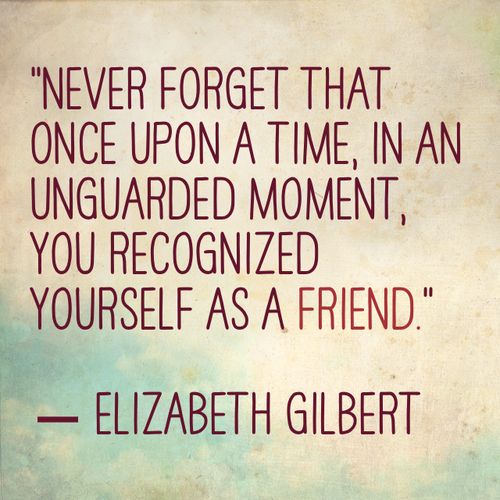
Recognizing Yourself as a Friend

friend

I love this quote (left) by Elizabeth Gilbert, an award-winning fiction and non-fiction writer.  I believe it to be an often-dismissed yet critically important reminder.

A few months ago I wrote a blog post about accepting and loving oneself, entitled: Being Kind To Yourself [ Shaking Off Comparison].  In it, I discussed the common struggle of negative self-talk & self-degradation in the light of not meeting our own highly-set expectations.  In that post I also asked this question: Are you as kind to yourself as you are to your family members, your friends, co-workers, classmates, and even strangers? In other words, do you offer-up to yourself the same kindness you freely give to others?

Sadly, for many the answer is no…

In this post I wanted to continue-on in this important topic of how we treat ourselves. Elizabeth Gilbert’s quote brings up an important question we should all ask: Am I a friend to myself?

Perhaps we should begin with defining friendship…

friend: (1) a person with whom one knows, likes, and trusts; (2) a person with whom one is allied in a struggle or cause; a comrade

This definition is in no way ground-breaking.  True, genuine friends see you – all of you. Friends know and adore your funny sense of humor, and laugh at your corny jokes as well as the stories you’ve told three times already. Close friends can see and admire your unique personality and way of being – your strengths and talents. Perhaps most importantly, true friends recognize your rough spots – your mistakes and challenges – and fully embrace you regardless. Through the thick and the thin, they are there with you: companions, loyal comrades.

The question, then, is: Do we embrace, cherish, and celebrate our own unique personality, abilities, and passions? Furthermore, can we recognize our own rough spots and embrace and allow ourselves grace regardless? Are we as loyal and compassionate to ourselves as we can be to the friends we love and cherish so dearly?

Returning back to the quote by Gilbert (above), I am struck by the words “in an unguarded moment.” What comes to mind when you read this? For me, I imagine a very young child spinning carefree in his parents’ backyard. In the summer heat, mom and dad have turned on the outdoor sprinkler for relief and he is now skipping back and forth in nothing but a now-drooping diaper. His smile stretches from ear to ear, covering his small face as his contagious laughter fills the air and warms the heart of his parents. He lives completely in the moment – entirely occupied by the coolness of the streaming water and the feeling of his bare feet in the green grass below him.  He lets out a high-pitch squeal as he jumps over the sprinkler head – running now as fast as his little legs will take him. How can he be anything but unguarded & unashamed in this moment? How can he be anything other than his own trusted friend?

And most of us can think back to these type of moments in our own lives – before designer clothes, cliques, GPA’s or career aspirations every mattered. Before we so quickly measured others up and ranked ourselves “accordingly”, looking for some defect in them to be satisfied with ourselves. Before we were damaged by the careless words of others, which we buried in the moment but left long-lasting scars. Before the world became tough so we got tough right back – built some walls, placing guardrails along the exterior of our heart and caution signs near the soft spots in our minds. Before  we turned against ourselves – no longer seeing ourselves as a friend but rather as a let-down, a failure, or possibly a desperate work-in-progress. Before all of that – we once upon a time saw that it was okay when we fell down because it only meant that we were just like everyone else: human.

Can we return to that child, that once-unguarded person who loved himself  and enjoyed his own company unashamedly? I believe we can… this time different, of course. Perhaps we are wiser now and sure, appropriate boundaries should be in-place. After all, the world can still be mean and circumstances of life can feel like ever-changing waves.  However, maybe we can begin letting ourselves in – giving ourselves a break and whispering “it’s okay” when we feel hurt and have had a bad day. Because it is okay. It is okay when you cry, and it is okay when you feel angry. It does not necessarily mean that you are wrong or a failure – but merely reflects that  you are a human with thoughts and emotions. And that is not only okay – it is healthy that your heart beats and you experience emotion.

How can you be a friend to yourself? Possibly by treating yourself as you treat your best friend…with understanding, compassion, and free of expectation of perfection. My prayer is that these words give hope and peace to those in need today.

__________________________________________________________________________________________

Learn more about Lydia Minear, MA, LAPC’s Counseling practice @ East-West Psychotherapy Associates here.

The Power of Vulnerability

In this post, I simply wanted to share a fantastic and eye-opening Ted Talk video, by Researcher and LMSW Brene Brown.  She presents findings from years of research on the power of vulnerability, the necessity of authenticity, and the importance of living wholeheartedly

I hope it challenges and inspires you as well. Enjoy!

__________________________________________________________________________________________

Learn more about Lydia Minear, MA, LAPC’s Counseling practice @ East-West Psychotherapy Associates here.

When You Change…

“It takes courage to grow up and become who you really are.” ~ E. E. Cummings

beachI recently went to the beach with my family. We returned to an island we hadn’t visited in many years. Being back there – a place of my childhood summers – granted me that lovely nostalgic feeling of returning to a place that I love and know well.

I realized that the beach, the homes, and the striking scenery of that place were very much the same. It kept its serene, subtle beauty. Barefoot strolls on the brown sand gave me the same comforting feeling I knew many years ago, and the refreshing touch of the calm ocean tide against my ankles presented me with the similar experience of feeling renewed by cool, salty water.  Looking out at the expanse of the large, far-reaching ocean in front of me again left me with the similar awe-inspired realization of how small I am in this big world.

However, as much as this beautiful beach seemed unaffected by time, I know that the same cannot be said about me. I have changed-I am no longer fifteen and wondering what I want to be “when I grow up.” And I expect that ten years from now, I will look back and say something similar about who I am today…

Perhaps it is for this very reason that so many of us are drawn to the beach, the mountains, and other naturally beautiful and seemingly unchanging scenic sanctuaries. As humans, we cling to those places and things that are constant in our lives. The ups and downs, twists and turns that life presents us with can be wearing – even the ones we know are healthy and important.

Yes, change is often hard.

Most new clients pursue therapy desiring, expecting, and needing positive change in their lives.  Discovering the beauty of it, of course, looks different for each person – perhaps it includes learning a better way of communicating with one’s spouse, acquiring new strategies for coping with the stress of balancing work & home, or developing acceptance of one’s personality and identity.  Each individual and situation is unique, and making changes can require varying amounts of intentionality and patience. Furthermore, each individual’s personal change can also mean incurring varying responses from family & friends.

Yep, sometimes your friends will not like it when you change.

And why is this the case? Probably for the same reason that we return to the same beach, fear ordering something different on the menu at our favorite restaurant, and tear-up when we finish the last page of an amazing book with characters we adore: change in those we love can unexpectedly create feelings of confusion, sadness, and possibly even loss. And this can be true even with knowledge that the change is helpful, positive, and good. Those precious loved ones in your life must get accustomed to your changes just as you are beginning to spread your wings and adjust to a different outlook and a new way of life.

Why else?

Some friends may not like it when you change because it challenges them to reflect on their own thoughts, feelings, and behavior. Possibly, it forces them to look at their own ‘elephants‘ they’ve kept hidden.

Going back to the quote by E.E. Cummings above the picture, courage is an essential ingredient when following the path of growth.  It often requires exposing oneself to new territory and being vulnerable to the reactions of others. Yet, without it, change is impossible.

“If there is no struggle, there is no progress.” ~ Frederick Douglas

So, what does change mean to you and how do you experience the tension in managing the common stretch marks that often accompany it?

__________________________________________________________________________________________

Learn more about Lydia Minear, MA, LAPC’s Counseling practice @ East-West Psychotherapy Associates here.

Embracing the Elephant in the Room [ My Heart for Psychotherapy ]

You simply cannot ignore an elephant in a room, especially not in a small room.  Well, you can for a time. Maybe you take special precautions to sit in the corner of the room, furthest from its large flopping ears and gray trunk. Perhaps you cover your ears when it lets out a shrill trumpet sound, close your eyes, and even hide behind your nearest friend as its large stocky legs draw nearer.  However, eventually elephants will make themselves known.  They may tear up an entire room doing so, but regardless, you’ll be forced to acknowledge them.

Most of us like real elephants but hate the metaphorical ones. The elephants in our hearts, minds, and lives that disturb us most often enter in uninvited. Psychologically we become experts at denial, pushing these problems and issues to the outskirts of our minds. “Out of sight, out of mind” becomes our philosophy. However, who are we kidding? Certainly not the elephant and probably not ourselves. The truth remains that the concern is still very much present, firmly standing its ground.

I passionately believe that one of the most important features of therapy is to allow a safe space for these elephants to be ‘unearthed’ and better understood. In other words, being vulnerable to the realities in our lives that we tend to dismiss-perhaps because they feel too large or too threatening-is a critical part of the process of personal awareness, growth, and healing.

Allowing clients a safe space to face these emotional elephants at their own pace lies at the heart of my passion for counseling. And why?

Because I know the personal impact it has made in my life.

I am so thankful for my first-ever counselor who challenged me to forge past my meticulously crafted and comfortable ‘topics to discuss’ list each week.  I’m so grateful for my therapist’s willingness to sit with me in the discomfort and tension [ and oftentimes uncomfortable silence ] which existed in the shrinking space between my elephant and me.  Finally, I am forever thankful for that time when I was allowed to move at my own slow pace towards the large, messy animal on the otherside of the room.  And by the time I found myself face-to-face with it, there was a certain inner peace and strength I gained from embracing the tension, crossing the divide, and vocalizing its reality in my life.

“Tension is the great integrity.” –Richard Buckmeister Fuller

I love this quote by R.B. Fuller who was an American architect, author, and inventor. As an architect, surely he understood the importance of literal tension in the building and structures he created.  For instance, even those of us with a minimal understanding of architecture recognize that that a bridge will collapse unless tension exists between the two base structures on either end. I similarly view the importance of recognizing and pressing-in to the emotional tension we may experience.

Pressing-in toward the tension requires vulnerability [ if you read my blog, you’ve likely noticed that I strongly believe in this word ] and humility. It can be difficult and even painful-perhaps comparable to taking off a bandaid, which has covered a deep scar for the first time. However, I feel that it is essential in wholly embracing who we are and where we are at.

__________________________________________________________________________________________

Learn more about Lydia Minear, MA, LAPC’s Counseling practice @ East-West Psychotherapy Associates here.

Counseling Q and A

So, in the beginning of last week I shared a post [ Questions ], in which I prompted readers to ask any and all questions regarding counseling [i.e. the process, purpose, risks, rewards, etc. ].

While I may not have received many questions, the two that I got were fantastic.

Question #1: What makes counseling any different from simply talking to a good friend?

This is a great question because I believe most people who consider entering into therapy will likely ask this. Afterall, it takes time, energy, and resources to begin the process of looking for a counselor as well as attending counseling.  The normal fears and feelings of nervousness, which often accompany opening yourself up to a new person and exposing your hurt, struggle, and pain, may also be present. You may ask yourself, “Wouldn’t it be simpler to just talk to my best friend?”

And to this, I would like to emphasize that counseling & the counselor-client relationship should never replace relational community in an individual’s life. Brilliant author, researcher, and LMSW, Brene Brown, explains that “We are neurobiologically wired for connection” [from her Ted Talk, The Power of Vulnerability ]. In other words, we need community. We are emotionally starved without it. Even the most introverted and content-to-being-alone persons amongst us will still experience this need to be with others and enjoy emotional intimacy. Again, counseling is not meant to a substitute for this. Instead, the therapeutic relationship is an altogether different kind of connection.

The counseling relationship is indeed a unique type of connection with another human being. I like to tell my clients that it is perhaps the one space for them to be 100% free to bring whatever emotion, thought, and experience they have to the table. In other words, nothing is off limits. If you are angry, be angry. If you are sad, hurt, bitter, or questioning-okay. You can be just that. Wherever you are at-fell free to be exactly that.

Oftentimes, this is not afforded in our outside worlds where we maintain certain roles and have specific responsibilities to fulfill. Even in our closest relationships and friendships, the freedom to be wholly you may not be afforded. Others often have expectations, after all. This is especially true when our thoughts, words, and actions can deeply affect another person. And this is not necessarily a negative thing-it is simply the reality of our lives.

The therapy relationship is purposed to be a safe & sensitive place, where an individual can bring the deepest parts of themselves – to be explored, processed, and understood. It is a space all about you. Further, a competent helping professional has not only been trained to provide this space but also has a passion for helping and keeping the focus on the client.

Question #2: How does a counselor help someone with an issue, which they personally have never experienced (i.e. abuse, trauma, addiction, loss of a loved one)?

This is another great question. Perhaps it is one you have asked before. “How can my therapist relate to what I’m going through…what I’ve been through in the past…and where I am at today.”  This is a normal and justified concern. After all, when we experience pain, we want to receive understanding and support from those who truly understand and have walked in similar shoes.

Many therapists provide support and counsel for persons with specific needs. While all counselors are trained in the knowledge of symptoms, causes, and treatment/recovery process for a variety of emotional difficulties, many therapists focus on a specific clientele.  Oftentimes, a counselor develops their counseling niche due to their own personal experiences, the struggle they have been through themselves, as well as the healing and recovery they have personally experienced. When searching for a professional helper, those who are competent will likely provide their specialities in their personal bio.  One great website, which provides Counselor Listings for specific areas of concern is TherapyTribe.

However, knowing a counselor’s client focus does not necessarily denote his or her personal experiences. Therefore, being honest and voicing what you need and desire in a counselor is important in the therapist-search stages.

Ethically, counselors are held to a high standard when providing treatment. According to the American Counselor Association’s Ethical Guidelines, “While developing specialty areas, counselors take steps to ensure the competence of their work, and to protect others from possible harm” (ACA, C.2.b.).  Futhermore, “The primary responsibility of counselors is respect the dignity and to promote the welfare of the clients” (ACA, A.1.a).  In other words, counselors who are upholding professional and ethical excellence in their field are honest about their abilities and strive to provide excellent services in their specialties. The most important purpose of counseling is to benefit the client. Compassionate and successful counselors recognize and act on this truth.

Alongside finding a therapist with a specialty you desire, it is perhaps most important to seek the counsel of a professional who can provide genuine, empathetic support. Through studying aspects of successful therapy, psychologist Carl Rogers was able to identify 3 critical, core characteristics of truly helpful therapists. These include:

1. Congruence [or Genuineness]– the willingness to transparently relate to clients. [In other words, does the counselor hide behind a mystical facade, or does he or she make intentional effort to genuinely relate to you as another human being?]

2. Unconditional Positive Regard – the counselor willingly offers acceptance and positive consideration of the client. [i.e., does the counselor provide a safe, non-judgmental environment in which you can thrive or does he or she simply exercise interruption, advice-giving, and judgment from a ‘superior’ position?]

3. Empathy – the therapist communicates a desire to understand the client’s experience, feeling, and thinking. [In other words, the counselor makes significant effort to understand where you as the client are coming from and what you are feeling.]

In order for a counselor to truly help an individual with an experience (which he or she as the therapist has never endured), these three characteristics are in my frank opinion necessary. The counselor should bring to each session a foundational humility in order to connect with you and allow your voice to be heard and your pain to be understood. This is the ultimate task of every therapist, I believe: to allow the client to be seen, his or her voice to be heard, and his or her hopes to be recognized.

I enjoyed answering these questions and I deeply appreciate those who took the time to ask. Please know that if you have any questions or concern in regards to counseling or me as a counselor, I’d love to chat. You can find me here.

__________________________________________________________________________________________

Learn more about Lydia Minear, MA, LAPC’s Counseling practice @ East-West Psychotherapy Associates here.

Questions

questions

Hi friends! I would love to provide a Blog Post where I address any and all questions people may have concerning Counseling [ the purpose, process, risks, rewards, etc. involved ]. Please feel free to email me at lminear@eastwestpsych.com or comment in the Contact Me page with any questions! I will be responding via the Blog at the end of the week on Friday July 12th. Thanks so much & I appreciate your taking the time to read the blog 🙂

__________________________________________________________________________________________

Learn more about Lydia Minear, MA, LAPC’s Counseling practice @ East-West Psychotherapy Associates here.

Being Kind to Yourself [ Shaking off Comparison ]

Be Kind to Yourself.

Sometimes the simplest of words ring the truest. I was told this by a therapist once, and well, it stuck.

Self-Talk:  a person’s internal dialogue, which can be positive and motivational or negative and demotivating.

In other, less technical and fancy words, self-talk includes all the mess we tell ourselves. This includes the good, as well as the bad. It can look like a motivational pep-talk you give yourself before entering an interview, and it can also appear as biting criticism you punish yourself with when you feel you haven’t “measured up.” I believe that too often we do not realize how impacting our self-talk truly is. We are constantly stuck in our own heads, after all. How much of the time are you stuck with your own voice, which lacks grace, love, and patience? How often are you willing to freely offer up kindness to others while refusing to offer it to yourself?

“You are your worst critic.”

I forget exactly when I heard the statement above for the first time. All I know is that I’ve heard it over and over, again and again by so many friends and family, and I am guessing that you’ve likely heard it too. However, hearing and recognizing are altogether different. In fact, knowing and believing do not necessarily go hand in hand. We can realize the negative self-talk we indulge  in and acknowledge the damage it does without truly believing that we deserve and need something different, something much more truthfully kind.

What are the barriers to being kind to oneself? What stands in the way? So much can block self-acceptance and self-kindness, but a big one that stands out to me is comparison.

Comparison: Bleh. Yuck.

It’s that aggravating, itch-you-can’t-scratch, readily-available, pesky little life-sucking bug, isn’t it? Measuring one’s life, relationships, career, family, and looks against the state of another’s usually ends in one of two ways: arrogance [feeling better than] or self-degradation [feeling less than]. It is so incredibly unhealthy and unfortunately so common. And there are far too many comparison tools readily available for us. The  presence of Facebook, Twitter, Instagram, and other social media outlets provides us, afterall, with unlimited ways of glancing at a snapshot of another’s life, holding it in view of our own and judging one’s own life based on the circumstances of another.

How silly, though, and how harsh. After allthe beauty of a mountain landscape does not make a sunset at the beach less marvelous to see.  Both take my breath away and remind me of the goodness of life and of God. Human beings-we are the same, I strongly believe. And thank goodness we are not all the same. Each of us, created with distinct personalities, preferences, and quirky little habits. Recognizing our differences does not have to depress us but rather can push us towards appreciating the complex beauty of this life and of the human condition.

So, how are you treating yourself, what words do you tell yourself, and in what way are you being gracious and kind to yourself today?

__________________________________________________________________________________________

Learn more about Lydia Minear, MA, LAPC’s Counseling practice @ East-West Psychotherapy Associates here.

Throwing Paperclips: Relationship Conflict & Communication

Imagine that you and I are sitting in a room together – I on one side of the room and you on the other. Unexpectedly, I pull out a jar of paperclips and begin throwing them at you, one right after another…How would you respond? You have a few options:

(a) run out of the room to avoid them altogether

(b) try covering your face to block the paperclips

(c) pick up the paperclips and begin throwing them back

OR (d) possibly a combination of the three


Perhaps whoever wins this “War of the Paperclips” is the person who throws the most clips and throws them the hardest, unrelenting until one of us, hurt and exhausted, finally gives up.

Now imagine how this “war” reflects the reality of taking sides and “throwing paperclips” in the midst of relational conflict.  Be it in your marriage, in your dating relationship, with your parents, sister, brother, friend, or roommate, you may find yourself on the throwing or receiving end of verbal attacks.

Everyone has heard the words: “The Key to a Healthy Relationship is Communication.”  But the key is not just any kind of communication, is it? Spurting out biting criticism, making wide-sweeping, negative claims, and offering up mean-hearted, sarcastic remarks, after all, does not build a healthy relationship.  Neither does it reflect love. Far too often, anger, frustration, resentments, jealousy, and bitterness clouds thinking & disables compassion & understanding for the other person.

Especially in marriage, we are meant to weather the storms of life together, hand-in-hand, on the same team. Unfortunately, projecting emotional and verbal darts at our loved one draws a harsh line in the sand, creating opposing teams. When this occurs – when forces are divided rather than joined – both sides lose out and the relationship suffers in the long-run.

Dr. John Gottman, leading therapist in the field of marriage, explains that an important principle towards saving a marriage is “turning toward each other instead of away.” (from The Seven Principles of Making Marriage Work). To me, this principle speaks to the heart of communication and conflict in relationships.  We turn away when we fear the other person’s harsh remarks. We turn away when we feel the need to protect ourselves & our own interests from the verbal darts being flung our way. However, we turn toward one another when we can trust that – no matter how difficult the concern or the problem – respect rather than contempt will guide the conversation.

The truth is that relationships are hard. They are difficult because like all good things, healthy relationships require sacrifice. Sacrifice in relationship looks a lot like putting aside one’s pride and desire to be right in order to save the state of the relationship through love & grace. To be honest, it looks nothing like throwing paperclips.  It also doesn’t look like sweeping them under the rug in order to avoid issues altogether. Instead, maybe it looks like taking out the jar, pouring the “paperclips” on the table in front of you both and working through each one with patience and respect together.

And if this feels unnatural or even awkward at first, you are not alone. However, through intentional thought and practice, turning toward one another and “laying down arms” builds the solid foundation of mutual love and respect necessary for long-lasting, fruitful relationships to grow.

__________________________________________________________________________________________

Learn more about Lydia Minear, MA, LAPC’s Counseling practice @ East-West Psychotherapy Associates here.